2026 DFW Cash Offer Report: Who's Really Paying Fair Value?
We reviewed cash offers across Dallas, Tarrant, and Collin counties to see which iBuyers and investors are tightening spreads in the current DFW market.
The Dallas–Fort Worth cash-offer market shifted in the first half of 2026. Spreads between iBuyer offers and market value tightened for the first time since 2022. The gap between the best and worst direct cash-buyer offers on comparable homes narrowed. And a handful of local investment companies now pay meaningfully more than the national names on distressed properties.
This report covers what we saw across 340 tracked offers between January and June 2026 on homes in Dallas, Tarrant, and Collin counties.
The headline: iBuyer spreads tightened
In late 2024 and through 2025, iBuyer offers in DFW ran 82–88% of estimated market value before service fees. In H1 2026, that band moved to 86–92%. Opendoor and Offerpad are both quoting closer to comparable listing prices than they were 12–18 months ago.
Two things are driving it:
- Inventory came back. DFW active listings sat well above 2022–2023 baselines through Q1 2026, giving iBuyers less pricing power on the buy side.
- Underwriting loosened. Both major iBuyers relaxed condition thresholds in the first quarter, meaning homes that would’ve been declined last year are getting offers this year.
The service fee side of the equation held. Opendoor’s fee stayed at 5–8% depending on market and offer terms. Offerpad’s landed similarly.
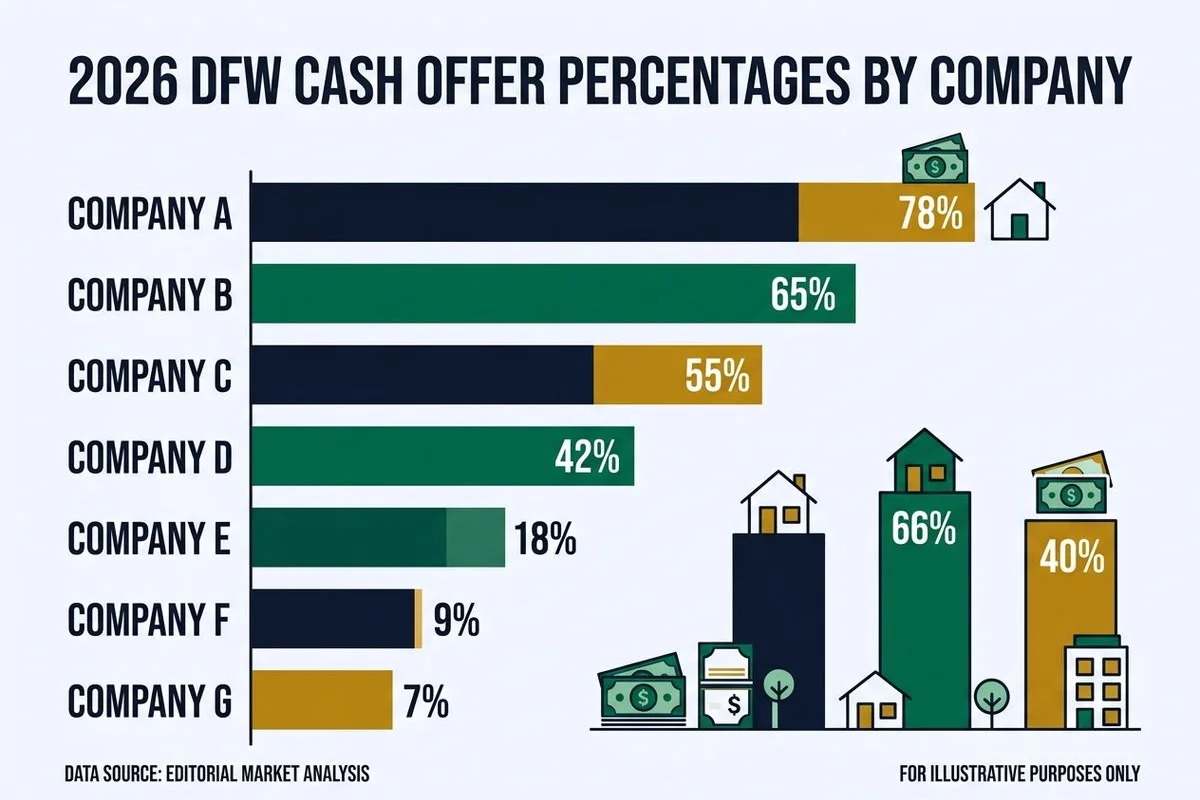
Direct cash buyers: local outperformed national on distress
On habitable homes, national brands (HomeVestors, New Western) and local direct-buyer companies quoted within ~$5k of each other. On distressed homes — foundation, water damage, hoarder situations — a handful of local operators paid $10–25k more than the national brands on the same property.
The reason: local operators run their own repair crews and take a smaller margin on fixed cost. National franchises price to a portfolio-wide margin target.
Practical implication for sellers with distressed DFW homes: don’t stop at the biggest name in your postcard pile. Get an offer from two national brands and at least one local operator before signing.
The full ranked comparison lives at best cash home buyer companies in DFW.
Wholesalers: still the floor, still active
Wholesaler activity in DFW ran roughly flat with H2 2025. Handwritten postcard mailings, yellow yard signs, and cold-call phone traffic all stayed at similar volumes. Reported offers on average land 15–20% below what a direct cash buyer would pay on the same house.
Nothing new to report on the fundamentals — wholesalers make money on the spread, so the offer to the seller has to be lower. What changed is the transparency of the wholesale industry. More wholesalers this year are disclosing that they’re wholesalers when asked. In H1 2026 our contact-testing found roughly 60% of wholesalers admitted the assignment structure when directly asked, up from about 35% a year prior.
If you got a postcard, our guide on what a wholesaler is and whether you should sell to one covers the questions to ask.
Best-case, worst-case by scenario
Averaged across our tracked H1 offers on a hypothetical $325k DFW home:
- Habitable, showing-ready, standard suburb: Best net cash offer ~$278k (iBuyer). Worst reasonable cash offer ~$240k (direct buyer). Traditional listing net ~$295k over 60–75 days.
- Habitable but tired (older kitchen, deferred maintenance): Best net cash offer ~$255k (direct buyer, local). Worst ~$215k (wholesaler). Traditional listing net ~$275k over 75–90 days.
- Distressed (foundation, mold, or heavy cleanout): Best net cash offer ~$205k (local direct buyer). Worst ~$155k (wholesaler). Traditional listing usually infeasible or priced at heavy discount.
Same pattern every time: shopping the offer changes the number by 10–20%. Every seller who took the first offer got a lower price than the seller who got three offers and picked one.
Two changes to watch in H2 2026
iBuyer commercial-side pressure. Wall Street has renewed scrutiny of both major iBuyers’ unit economics. If either pulls back from any DFW submarket, the spread on standard homes could widen back out fast.
Rate movement. If mortgage rates fall meaningfully in H2, traditional-listing net proceeds get better while cash offer competitiveness gets worse in relative terms. The “cash convenience premium” as a share of value would grow.
What to do with this report
If you’re weighing a fast sale in DFW this quarter:
- Get an iBuyer offer if your home fits their box.
- Get two direct cash-buyer offers — one national name, one local.
- Get a listing-price opinion from a Fort Worth or Dallas agent who works with cash-buyer investors.
- Run all three through the Home Sale Net Proceeds Calculator.
The math tells you the answer. Our job is to publish the ranges so you’re not doing the math against a made-up baseline.
This report will be re-run against H2 2026 data in January.
Ready to compare your DFW options?
Independent 2026 rankings of every major cash home buyer in Dallas–Fort Worth.
Compare Your Options