Skip to content

Texas Home Selling Costs - What You Actually Walk Away With

The cost hub anchoring all seller-cost, fee-breakdown, and home-value content with a worked Texas net-proceeds example.

Last updated:

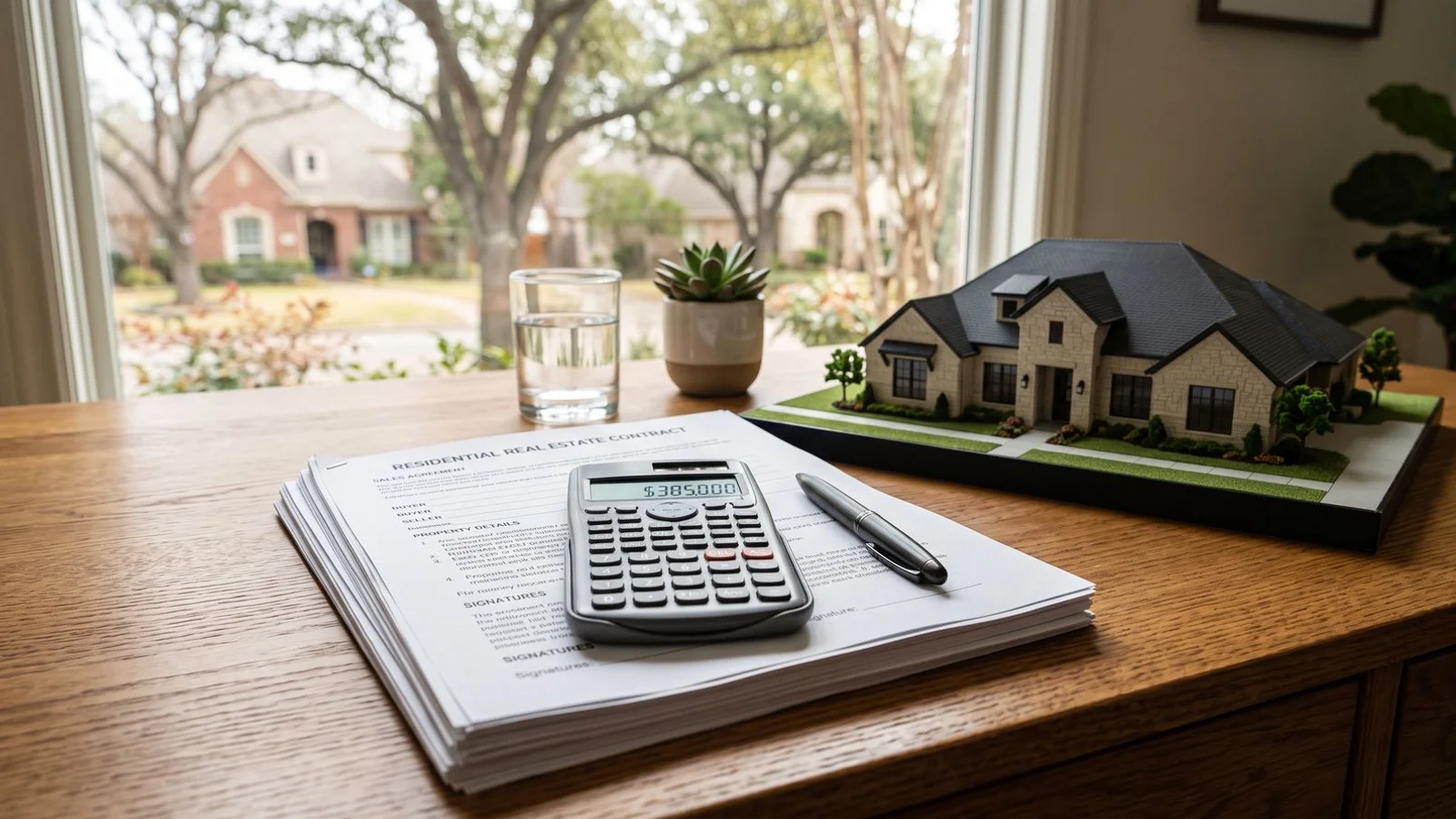
DFW Real Estate Review seller cost breakdown with calculator, contract, and model Texas home
Licensed Texas Agent (TREC #679806) Independent since 2016 Full referral disclosure

What this hub covers

  • Full Texas seller-cost breakdown with a worked net-proceeds example
  • Company fee analyses (Opendoor, Offerpad): headline offer vs. net
  • Hidden costs of selling to a cash buyer
  • Home-value tool comparison and DFW market context

What Sellers Pay at Closing in Texas

DFW Real Estate Review breaks down every cost Texas sellers face at closing - from commission and title policy to escrow, prorations, concessions, and mortgage payoff. Whether you’re selling a single-family home in Plano, a townhouse in Arlington, or a fixer-upper in South Dallas, the math follows the same structure. This page walks through every line item for Texas specifically, then compares that to what a cash sale actually nets. All figures reflect 2026 DFW market conditions and are reviewed by a licensed Texas real estate agent (TREC #679806) with nearly a decade covering the Dallas-Fort Worth market.

If you want to skip to the arithmetic, the Home Sale Net Proceeds Calculator does it in-browser.

Commission, Closing Costs, and Concessions on a Traditional Listing

Agent commission. In Texas the customary combined commission is 5-6%, split roughly equally between the listing agent and the buyer’s agent. A $350k sale at 5.5% is $19,250. Since the 2024 NAR settlement, buyer agent compensation is no longer guaranteed through the MLS - sellers in Dallas-Fort Worth should factor this into their listing strategy. Commission is negotiable and there are discount and flat-fee models - our commission savings calculator compares them.

Seller closing costs. In Texas the seller customarily pays for:

  • Owner’s title policy: calculated by the Texas Department of Insurance rate schedule, roughly 0.5-0.6% of sale price for homes in the $200-500k range. On $350k that’s about $2,000.
  • Escrow and closing fees: typically $400-$800 at most DFW title companies.
  • HOA transfer and resale certificate: $200-$500 if there’s an HOA.
  • Prorated property taxes: your share of the year to closing date. In Collin County and Denton County, where property tax rates often exceed 2.2%, this proration can be substantial.
  • Prorated HOA dues: same.
  • Miscellaneous document / delivery / recording fees: $200-$500.

Total seller-side closing costs in 2026 typically land at 1-3% of the sale price.

Concessions after inspection. Buyers commonly negotiate seller credits after the option-period inspection. On a standard single-family home in acceptable condition, expect $2,000-$5,000 in credits or repairs. Older homes in neighborhoods like Oak Cliff or East Fort Worth tend to see higher repair requests due to foundation movement on the area’s expansive clay soil.

Mortgage payoff. Whatever’s left on the loan, plus accrued interest to closing date, plus any early-payoff or reconveyance fees. Get the payoff quote from your servicer 3-5 business days before close.

Worked example, $350k Texas listing:

  • Gross sale price: $350,000
  • Commission (5.5%): −$19,250
  • Closing costs (1.5%): −$5,250
  • Concessions: −$3,000
  • Mortgage payoff: −$150,000
  • Net to seller: $172,500

That’s the reality check number DFW Real Estate Review uses when comparing any cash offer to a traditional listing.

Cost line itemTypical range (traditional listing)On a $350k Texas sale
Agent commission5-6% of sale price$17,500-$21,000
Seller closing costs1-3% (title, escrow, prorations)$3,500-$10,500
Buyer concessions after inspection$2,000-$5,000$2,000-$5,000

Dallas-Fort Worth homeowner reviewing net proceeds and closing cost math on laptop

How Much a Cash Sale Actually Nets You

Headline cash offers exclude several deductions that reduce what hits your account:

iBuyer service fee. Opendoor and Offerpad both take a 5-8% service fee off the top of the offer. On a $325k iBuyer offer with a 7% fee, that’s $22,750 gone before you see a check.

Repair “adjustments”. Both iBuyers and direct cash buyers reduce the offer for estimated repair costs found during their inspection. This is the biggest source of surprise for sellers - the initial verbal offer can drop $10-30k after inspection.

Closing costs. On a cash sale, the buyer often pays most or all of the closing costs. Confirm this in the contract; don’t assume.

Repairs and concessions. Usually $0 on a true cash / as-is sale. That’s the main compensating factor.

Mortgage payoff. Same as traditional - you still owe what you owe.

Worked example, $350k value cash sale to an iBuyer:

  • Initial offer (88% of value): $308,000
  • Service fee (7%): −$21,560
  • Repair adjustments: −$8,000
  • Closing costs (paid by buyer): $0
  • Mortgage payoff: −$150,000
  • Net to seller: $128,440

A traditional listing on the same house nets $172,500. A cash sale nets $128,440. The traditional sale is $44,060 more - that’s what “convenience” costs on this specific home. On a distressed home that can’t be listed traditionally, that math flips.

Five Factors That Change Your Net Proceeds the Most

  1. Which lane you sell in. Traditional listing > iBuyer > direct cash buyer > wholesaler, in that order for a habitable home. On distressed properties - foundation problems, fire damage, hoarder houses - a direct cash buyer is often the only real option.
  2. Whether you shop the offer. Two or three competing offers change the net by 5-15%. Every time.
  3. What condition the buyer sees. Small pre-sale investments (a clean carpet, decluttering, a functioning HVAC) meaningfully change the offer even on as-is deals.
  4. Whether you understand the fee structure. Companies that quote 88% but net 78% aren’t lying - they’re relying on you not doing the math.
  5. How much you owe. Payoff is what it is, but a HELOC or second lien can catch sellers off guard.

Before you sign anything, run your numbers.

Free, no email required

See what your DFW home actually nets.

Run the numbers before you sign anything. Two free calculators, no lead-capture wall.

How It Works

1

Start with gross sale price

This is the number in the contract, the number that gets you excited. Everything from here is subtraction until you get to what actually hits your account.

2

Subtract commissions and closing costs

Combined agent commission is typically 5-6% in Texas. Seller-side closing costs (title policy, escrow, prorations, doc fees) add another 1-3%. On a $350k sale that's $21k-$31k off the top.

3

Subtract concessions and repairs

Buyer credits after inspection average $2-5k on a standard home. Bigger for older or distressed properties.

4

Subtract mortgage payoff

The lender payoff figure includes principal, accrued interest to closing date, and any early-payoff or reconveyance fees. Get the payoff quote from your servicer directly.

Why this coverage is different

Worked Texas examples, not generic averages

Every number here is computed against Texas closing standards: title policy calculated by state formula, prorations done the way Texas title companies do them.

Independent fee breakdowns

We publish fee analyses for the specific companies DFW sellers get offers from: Opendoor, Offerpad, HomeVestors, with the actual line items.

Free calculator, no lead-capture wall

The [Net Proceeds Calculator](/tools/net-proceeds-calculator/) runs in-browser. You don't have to give us an email to see your number.

Reader feedback

What DFW Sellers Say

★★★★★

"The Opendoor fee breakdown showed me the difference between the headline offer and what actually hits my account. That number was nothing like what the app implied."

Priya S. Irving, TX

Frequently Asked Questions

What does it typically cost to sell a house in Texas?

On a traditional listing: 5-6% agent commission, 1-3% seller closing costs (title policy, escrow, prorations, doc fees), $2-5k in buyer concessions after inspection, and any remaining mortgage payoff. On a $350k sale, total costs before payoff typically land at $28k-$40k.

Do sellers pay closing costs in Texas?

Yes. Sellers customarily pay for the owner's title policy (calculated by state rate schedule), escrow / closing fees, HOA transfer fees, and their share of prorated property taxes and HOA dues. Buyers pay their own loan and inspection costs.

What's the hidden cost of a cash offer?

iBuyers charge a 5-8% service fee that's separate from the headline offer. Direct cash buyers deduct their estimated repair costs from the offer even if you don't do the repairs - meaning a $250k offer might net you $200k after adjustments. Our [Opendoor fee breakdown](/guide/how-much-does-opendoor-charge-in-dallas/) and [Offerpad fee breakdown](/guide/how-much-does-offerpad-charge-in-dfw/) show the actual line items.

Are there tax implications when I sell a Texas home?

Texas has no state income tax, so there's no state capital gains tax at the sale itself. Federal capital gains still applies - the primary-residence exclusion covers up to $250k of gain ($500k married filing jointly) if you've lived in the home 2 of the last 5 years. Our [capital gains guide](/guide/capital-gains-tax-when-selling-a-home-in-texas/) covers the details.

What's the single biggest cost most DFW sellers underestimate?

Agent commission. On a $350,000 DFW home, a traditional 5-6% commission is $17,500-$21,000 - usually far larger than title, escrow, and closing costs combined. It's also the most negotiable line item: flat fee MLS and discount brokers can cut it dramatically. Run your numbers through the [Commission Savings Calculator](/tools/commission-savings-calculator/) before you sign a listing agreement.

Ready to weigh your DFW options?

Independent 2026 rankings, real fee breakdowns, and free calculators.