Capital Gains Tax When Selling a Home in Texas
Selling your Texas home? Understand the $250K/$500K primary-residence exclusion, cost basis, and when tax actually applies. Consult a CPA.
Last updated:

We know how stressful it is trying to figure out capital gains tax selling home texas, especially when most advice online ignores local market realities. You are likely sitting on a lot of built-up equity, considering the DFW median home price hit roughly $395,000 in early 2026.
Our team at DFW Real Estate Review built this specific guide because we are tired of generic national articles misleading North Texas homeowners. This data actually dictates what you keep in your pocket after closing.
We will break down exactly how the federal exclusion works, how to calculate your true cost basis, and when taxes actually apply to your sale.
Let’s look at the numbers.
The $250K/$500K primary-residence exclusion
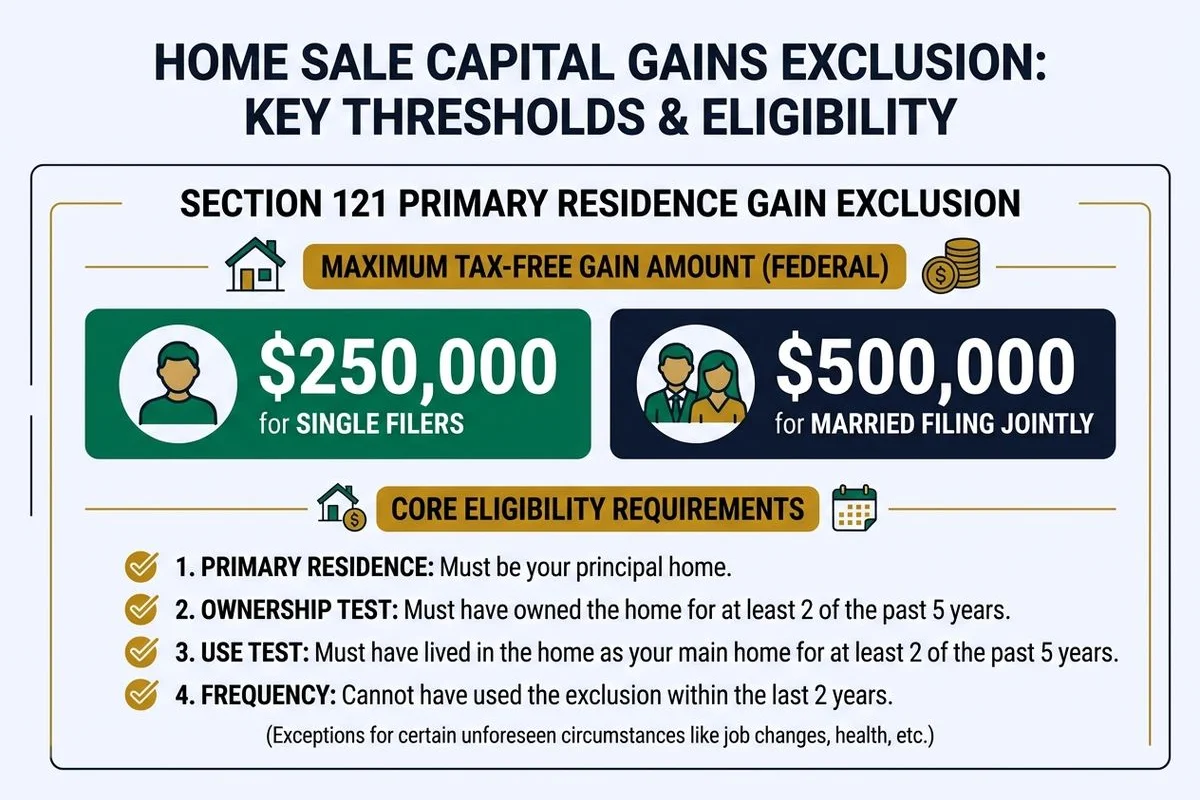
You can avoid federal taxes on up to $250,000 of profit if you file singly, or up to $500,000 if married filing jointly, through the IRS Section 121 exclusion. The IRS requires you to have owned and lived in the house as your primary residence for at least two of the five years before the sale date.
We see sellers misunderstand how this rule applies to their specific property appreciation every day. Dallas and Fort Worth home values have surged substantially over the past five years. Our clients often panic because their Tarrant or Collin County home doubled in value. The reality is that the $500,000 married exclusion fully covers the vast majority of standard residential sales in North Texas today.
We want you to see exactly how these numbers look in practice. Here is a quick breakdown of the 2026 ownership and use tests:
- The Ownership Test: You must have owned the property for at least 24 months out of the last five years.
- The Use Test: You must have slept there and used it as your main home for at least 24 months.
- The Exceptions: Active duty military and certain government officials can suspend this five-year window for up to 10 years.
- The Frequency Limit: You cannot claim this specific exclusion if you already used it on another home sale in the past two years.
Our team always tells sellers to look at their net proceeds rather than just the final sale price. Most sellers in this situation get tripped up by not accounting for the timing and closing costs. Before you commit to any option, run your numbers against the Home Sale Net Proceeds Calculator so you are comparing net-to-you, rather than just a headline offer.
How cost basis is calculated
Your cost basis is the original purchase price of your home plus the cost of any major capital improvements you made over the years. This calculated number is subtracted from your final sale price to determine your actual taxable profit.
We often find that homeowners forget to include expensive upgrades when doing this math. A new roof installed after a bad Texas hail storm adds directly to your basis. Our favorite tip is to dig up old receipts for things like a central HVAC replacement or a new backyard pool. These are not just routine maintenance expenses; they are capital improvements that actively lower your potential tax burden.
We use a simple framework to help sellers categorize their expenses correctly based on IRS Publication 523 guidelines.
| Expense Type | Examples for DFW Homes | Adds to Cost Basis? |
|---|---|---|
| Capital Improvements | New HVAC, adding a pool, full roof replacement | Yes |
| Selling Costs | Title insurance, agent commissions, legal fees | Yes |
| Routine Maintenance | Fixing a leaky pipe, mowing the lawn, painting | No |
| Temporary Fixes | Replacing a single broken window pane | No |
Our understanding of the mechanical reality is that your practical read changes based on the DFW market and your specific home. Under Texas law, standard seller obligations and disclosures apply here just as they do anywhere in the state. Local conditions, like buyer availability, county specifics, and the current market temperature, will absolutely shift the outcome.
We know that documented condition assessments make a massive difference when finalizing these numbers. Practical implication for DFW: this is where competing offers matter. One offer is just a starting price. Two or three offers with a documented condition assessment become a real negotiation.
When capital gains tax selling home texas actually applies
Taxes only apply when your net profit exceeds your allowable Section 121 exclusion amount, and you only pay federal capital gains rates because Texas has no state income tax. If your profit surpasses that $250,000 or $500,000 threshold, you will owe federal taxes on the overage based on your income bracket.
We love reminding local sellers that the State of Texas will take exactly zero percent of your real estate profit. A proposed 2025 state constitutional amendment even pushed to ban capital gains taxes permanently. Our clients are relieved to learn they only need to worry about the federal IRS tax rates.
The IRS sets specific 2026 federal brackets for single and married filers. We want you to see exactly where those income thresholds apply.
- 0% Rate: Applies to single filers making up to $49,450 and married couples making up to $98,900.
- 15% Rate: Hits single filers earning between $49,451 and $545,500, and married couples up to $613,700.
- 20% Rate: Triggers only for high earners exceeding those $545,500 or $613,700 income limits.
- Net Investment Income Tax: An extra 3.8% surcharge applies to certain high-income earners on top of their base capital gains rate.
Our experience shows that local market dynamics still impact your final tax exposure. The mechanical reality of tax law is clear, but the practical read changes based on the DFW market and your specific home. Under Texas law, standard seller obligations apply here just as they do anywhere in the state. Local conditions like buyer availability, specific county tax assessments, and the current market temperature all shift the outcome.
We tell sellers to use this information during the actual sale process. Practical implication for DFW: this is where competing offers matter. One offer is simply a starting price. Two or three offers with a documented condition assessment create a competitive negotiation.
CPA disclaimer: not tax advice
We are licensed Texas real estate professionals, not certified public accountants or tax attorneys. You must consult a qualified tax professional to verify how federal tax codes apply to your specific financial situation.
We highly recommend working with a local professional registered with the Texas Society of CPAs. They understand the nuances of North Texas real estate and can help you complete complex federal filings like Form 8949 or Schedule D. Our team can guide you through the property transaction, but we cannot legally file your tax returns or offer binding financial advice.
“A great real estate agent maximizes your sale price, while a great CPA minimizes your tax liability. You need both to protect your equity.”
Collaborating with both a real estate agent and a financial advisor consistently yields the best results. The mechanical reality of the sale is handled by your agent, while your CPA handles the tax implications. Under Texas law, your seller obligations and disclosures apply here as they do anywhere in the state. Local conditions, including buyer availability and the current market temperature, will shift the outcome of your final net proceeds.
Our best advice is to gather your documentation early to share with your accountant. Practical implication for DFW: this is where competing offers matter. One offer is just a starting price. Two or three offers with a documented condition assessment become a real negotiation.
Where to go next
Understanding the nuances of capital gains tax selling home texas is just one piece of a much larger puzzle. If you are weighing your next steps, start by reviewing our parent hub on the cost to sell a house in texas. Related situation guides link out directly from there to help you plan.
We know every property situation is unique. Still unsure which lane fits your specific home?
Contact us today, and our team will point you to the right guide or company review to get you started.
Related guide: inherited-property gains
FAQ
Do I pay capital gains when selling my Texas home?
Often not, thanks to the $250K (single) / $500K (married) primary-residence exclusion.
Does Texas have a state capital gains tax?
No — Texas has no state income tax; federal rules apply.
When does tax apply?
When your gain exceeds the exclusion or it wasn't your primary residence long enough.