Hidden Costs of Selling to a Cash Buyer in DFW
The headline cash offer isn't your net. See the service fees, repair deductions, and closing-cost shifts that erode a DFW cash offer.
Last updated:

If you’re searching for information on hidden costs of selling to a cash buyer in dfw. this guide walks through what actually matters for a DFW seller. It’s written by a licensed Texas real estate agent (TREC #679806), not a national writer who’s never worked the market.
Seller wanting to know a cash offer’s real net after deductions. Below: the details that decide the outcome, the specific Texas or DFW context, and the CTAs that fit your situation.
Service fees on iBuyer and marketplace offers
Service fees on iBuyer and marketplace offers are non-negotiable charges that typically consume 5% to 8% of your home’s sale price right off the top. We review hundreds of transaction settlements, and these flat rates are just the beginning of the mechanical reality.
Under Texas law, seller obligations and disclosures apply here as they do anywhere in the state. Local conditions shape the final outcome based on several key factors:
- Dallas-Fort Worth Buyer Availability: Fewer active buyers mean higher risk fees deducted from your offer.
- County Specifics: Different markets carry varying holding cost projections.
- Current Market Temperatures: Slower sales periods increase the institutional service charges.
A major pitfall for DFW sellers is failing to account for the timing and cost side of these digital platforms. Companies like Opendoor charge a standard 5% service fee in 2026. Offerpad charges up to 8% depending on the property condition.
Before you commit to any option, run your numbers against the Home Sale Net Proceeds Calculator so you’re comparing net-to-you, not headline offer.
Understanding the True Convenience Cost
Many homeowners overlook the total convenience cost baked into a marketplace offer. You must factor in the combination of service fees and built-in equity spreads. Recent SEC Form 10-K filings show that the effective spread for local properties runs 12% to 18% below actual market value.
We suggest reviewing these three common marketplace expenses before signing anything:
- Standard Service Fee: Usually 5% of the purchase price, mirroring a traditional agent commission.
- Holding Costs: Sometimes categorized as risk fees, covering the time it takes the company to resell the house.
- Market Risk Adjustments: Extra percentage points deducted in shifting submarkets like Collin or Denton County.
Repair deductions after inspection
Repair deductions after inspection are the largest hidden cost, often reducing your net proceeds by $7,000 to $40,000 in North Texas. This adjustment is the mechanical reality of selling to an investor who plans to flip or rent the property.
The practical read is what changes based on the DFW market and your specific home condition. Under Texas law, seller obligations and disclosures apply here as they do anywhere in the state. Local conditions like seasonal buyer availability and current market temperature will dictate how aggressive these deductions get.
Handling DFW Soil and Structural Realities
Our preferred strategy is to anticipate the region’s most common structural issues before requesting bids. Foundation settling is practically guaranteed in local clay soil. Average foundation repair costs in Frisco, Plano, and McKinney range from $5,000 to $8,500 in 2026.
You can expect an inspector to recommend 8 to 12 steel pressed piers for a typical slab home. Wholesale buyers and iBuyers will deduct this full retail cost from your initial offer.
The Most Common DFW Repair Deductions
Corporate buyers rarely let you hire your own contractor to fix the problem cheaply. We see them use internal pricing models to mandate steep repair credits. They present a revised offer right before your option period expires.
Practical implication for DFW, this is where competing offers matter. One offer is a starting price. Two or three offers with a documented condition assessment become a real negotiation.
Here are the repairs cash buyers penalize most heavily:
- Foundation Stabilization: Up to $15,000 deducted for moderate leveling and root barriers.
- Roof Replacements: North Texas hail damage often triggers automatic $10,000 to $15,000 reductions.
- Cast Iron Plumbing: Pre-1980s homes in Dallas County regularly see $20,000 deductions for under-slab leaks.
- HVAC Systems: Aging air conditioners prompt $6,000 to $8,000 credits to account for summer heat strain.
Closing-cost shifts
Closing-cost shifts occur when cash buyers force sellers to pay specific administrative fees normally covered by the purchaser. You will typically spend 1% to 3% of the sale price on seller closing costs in Texas, excluding any agent commissions.
That is the mechanical reality for standard transactions. The practical read is what changes based on the DFW market and your specific home contract.
Title Insurance and Regulated Premiums
Our experience shows that institutional buyers often shift title search fees and document preparation costs onto the seller. Under Texas law, all title insurance premiums are regulated and set by the Texas Department of Insurance (TDI).
The state-promulgated rate for an owner’s title policy on a $400,000 home is roughly $2,386 in 2026. You are traditionally expected to pay this owner’s policy for the buyer. Local conventions shift when you deal with aggressive wholesale investors.
Texas-Specific Fee Obligations
Many fast-cash contracts are written to benefit the investor at the closing table. We always advise clients to read the fine print regarding property taxes. Texas taxes are paid in arrears, meaning you will owe prorated property taxes from January 1st through your closing date.
Dallas and Tarrant counties have effective tax rates hovering around 2.0% to 2.5%. This proration can easily deduct thousands of dollars from your final check.
| Closing Cost Item | Traditional Sale Standard | Cash Buyer Reality |
|---|---|---|
| Owner’s Title Policy | Seller pays state-regulated rate | Seller pays state-regulated rate |
| Escrow/Settlement Fee | Split 50/50 | Often shifted 100% to seller |
| Property Tax Proration | Seller pays through closing date | Seller pays through closing date |
| Survey Fee | Buyer typically pays | Seller forced to provide or pay |
Practical implication for DFW, this is where competing offers matter. One offer is a starting price. Two or three offers with a documented condition assessment is a negotiation.
The offer-vs-net gap illustrated
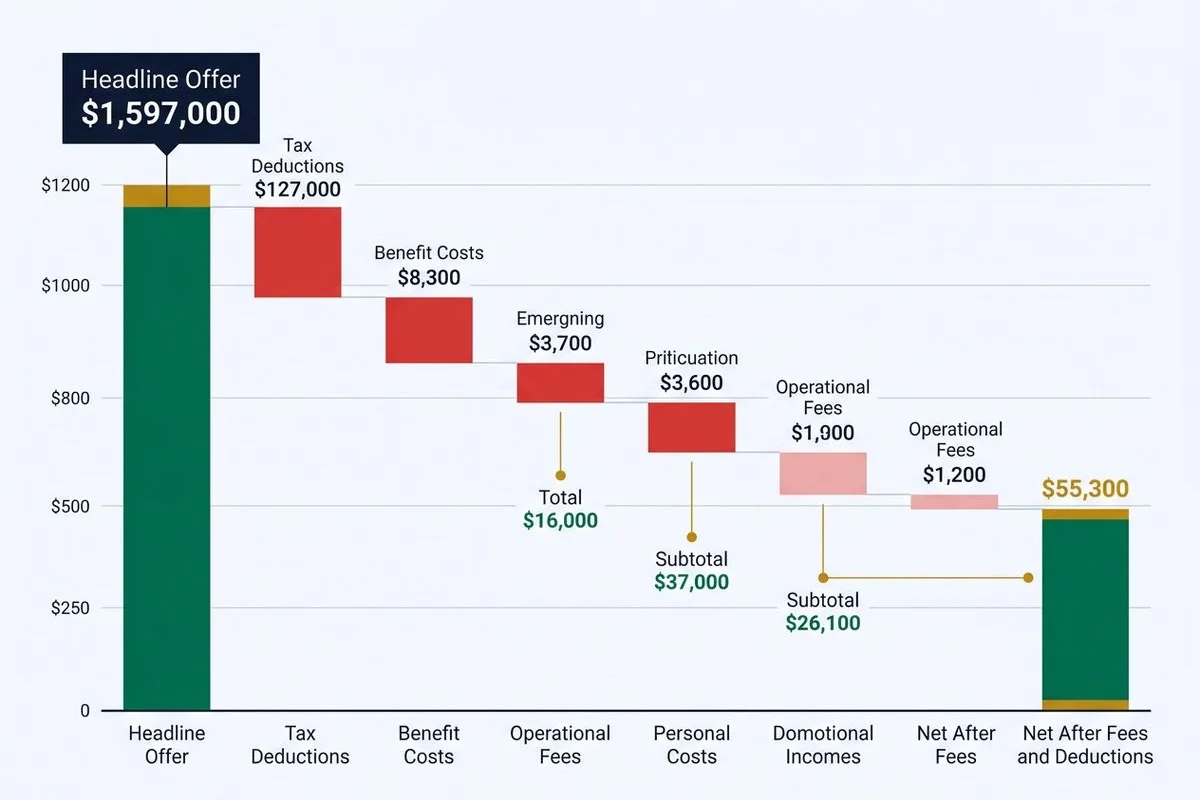
The offer-vs-net gap illustrated shows that sellers typically walk away with 15% to 30% less than their home’s fair market value. This math exposes the hidden costs of selling to a cash buyer dfw homeowners encounter when trading equity for speed and convenience.
The practical read is what changes based on the DFW market and your specific home. Our data indicates that a $400,000 initial cash offer rarely results in a $400,000 wire transfer.
Under Texas law, seller obligations and disclosures apply here as they do anywhere in the state. Local conditions and county specifics will shift the outcome of your final settlement statement. You must look at the entire picture to see the true cost of a quick sale. The gap is created by stacking service fees, repair deductions, holding costs, and closing expenses.
A Real-World DFW Scenario
Let us look at a realistic breakdown for an average Dallas-area home in 2026. We regularly audit settlement statements to track exactly where the money goes. An “as-is” investor must factor in their own holding costs and a 10% to 15% profit margin before they resell.
Here is how a $400,000 fair market value property breaks down with a typical corporate buyer:
- Initial Headline Offer: $380,000 (Already 5% below market value).
- Service Fee Deduction: $19,000 (Based on a standard 5% platform fee).
- Repair Credit Deduction: $12,000 (Average cost for moderate foundation and cosmetic fixes).
- Seller Closing Costs: $4,500 (Title policy and shifted escrow fees).
- Final Net Proceeds: $344,500.
Practical implication for DFW, this is where competing offers matter. One offer is a starting price. Two or three offers with a documented condition assessment is a negotiation.
Where to go next
The best next step is to evaluate your specific timeline and financial goals against these realistic deductions. This guide is one piece of a larger topic detailing regional real estate strategies.
If you’re weighing next steps, start with the parent hub: cost to sell a house in texas. Our team recommends comparing multiple vetted options side-by-side using the related situation guides that link out from there.
Still unsure which lane fits your specific home?
Contact us and our experts will point you to the right guide or company review.
Related guide: what cash buyers pay
FAQ
Are there hidden fees when selling to a cash buyer?
Often — service fees, repair credits, and closing-cost shifts reduce the headline.
Why is my net so much lower than the offer?
Deductions for fees and repairs come out before you receive proceeds.
How do I avoid surprises?
Ask for a net-proceeds sheet up front and compare buyers on net.