How Much Do Cash Buyers Actually Pay in DFW?
Real DFW offer data: what iBuyers, investors, and we-buy-houses companies actually pay as a % of value, and what moves the number.
Last updated:
We hear the same question from property owners every week regarding how much do cash buyers pay dfw.
The numbers are often confusing.
Our team at DFW Real Estate Review built this independent guide for North Texas homeowners who are tired of generic national advice. You need realistic offer-percentage expectations before calling an investor.
We want to walk through the details that actually decide the outcome for a local seller. This guide is written by a licensed Texas real estate agent (TREC #679806).
Our experience shows that local conditions shift the final numbers. Run your estimates against the Home Sale Net Proceeds Calculator before committing to any option, so you compare the net-to-you instead of the headline offer.
Offer-% ranges by buyer type: How much do cash buyers pay dfw?
We see cash offers in Dallas-Fort Worth ranging anywhere from 50% to 100% of fair market value. The final number depends entirely on the buyer’s business model.
Our analysts track these mechanical realities closely because the practical read changes based on your specific property. Under Texas law, seller obligations and disclosures apply here just like they do anywhere in the state.
We find that most sellers get tripped up by not accounting for the timing and cost side. The DFW market temperature dictates buyer availability.
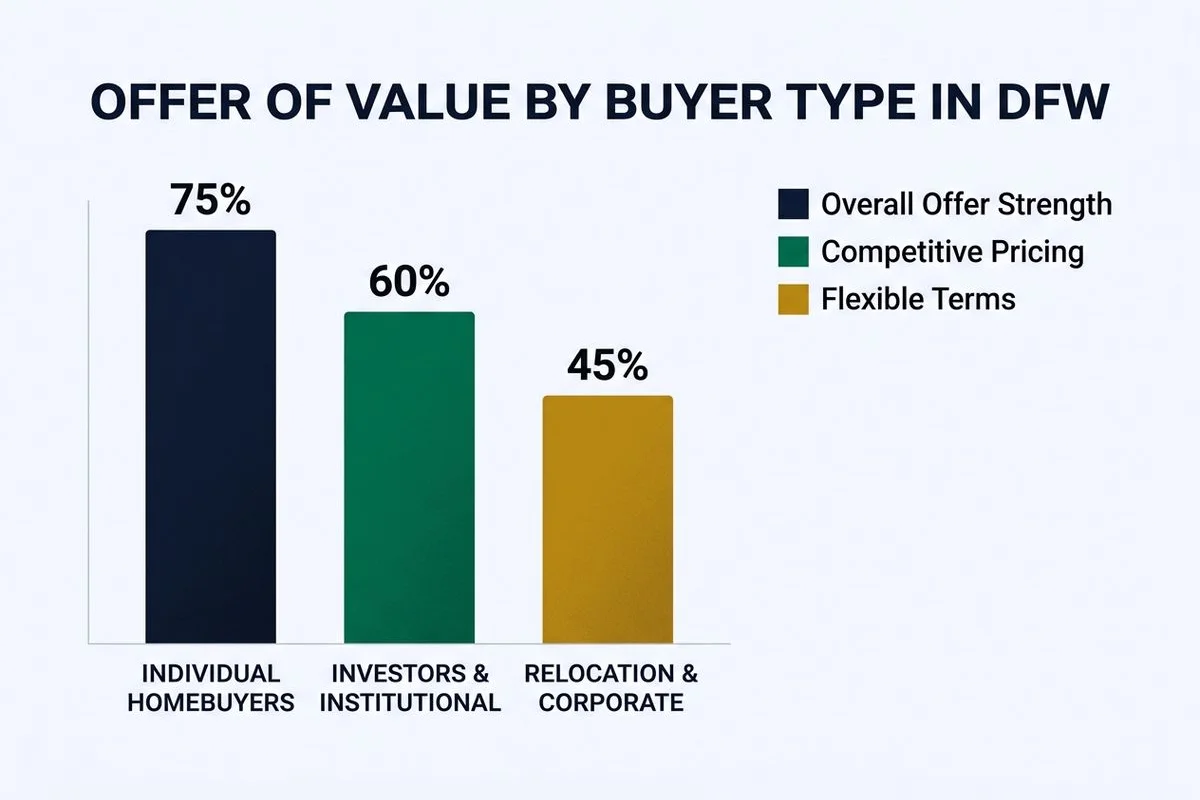
| Buyer Type | Typical Offer (% of Value) | Expected Fees |
|---|---|---|
| iBuyer (e.g., Opendoor) | Near market value (90-95%) | 5% service fee + repair credits |
| Local DFW Investor | 70% - 85% | No fees, but lower offer price |
| Wholesaler | 50% - 70% | Built-in margin before assigning |
Our research into 2026 data shows iBuyers like Opendoor or Offerpad will present a high initial percentage. Those numbers often drop once their required repair credits are subtracted from the total.
Sample offers vs. fair market value
We calculate sample offers by looking at the current 2026 Dallas-Fort Worth median home sale price. That number sits around $395,000 to $415,000.
Our recent market data reveals that a 75% offer on a $400,000 home yields a $300,000 starting price. The practical read is what changes based on the DFW market and your specific home condition.
We emphasize that local conditions shift the outcome dramatically. A single offer is just a starting point.
Our best advice is to secure two or three offers with documented condition assessments to create real negotiation leverage. This strategy forces buyers to compete for your property.
- The Baseline: Start with the $400,000 Fair Market Value.
- The Investor Margin: Subtract 20% for their required profit and holding costs.
- The Repair Reality: Deduct another $15,000 for estimated local labor and materials.
- The Final Number: The actual cash offer lands near $305,000.
Factors that move the number (condition, location, repairs)
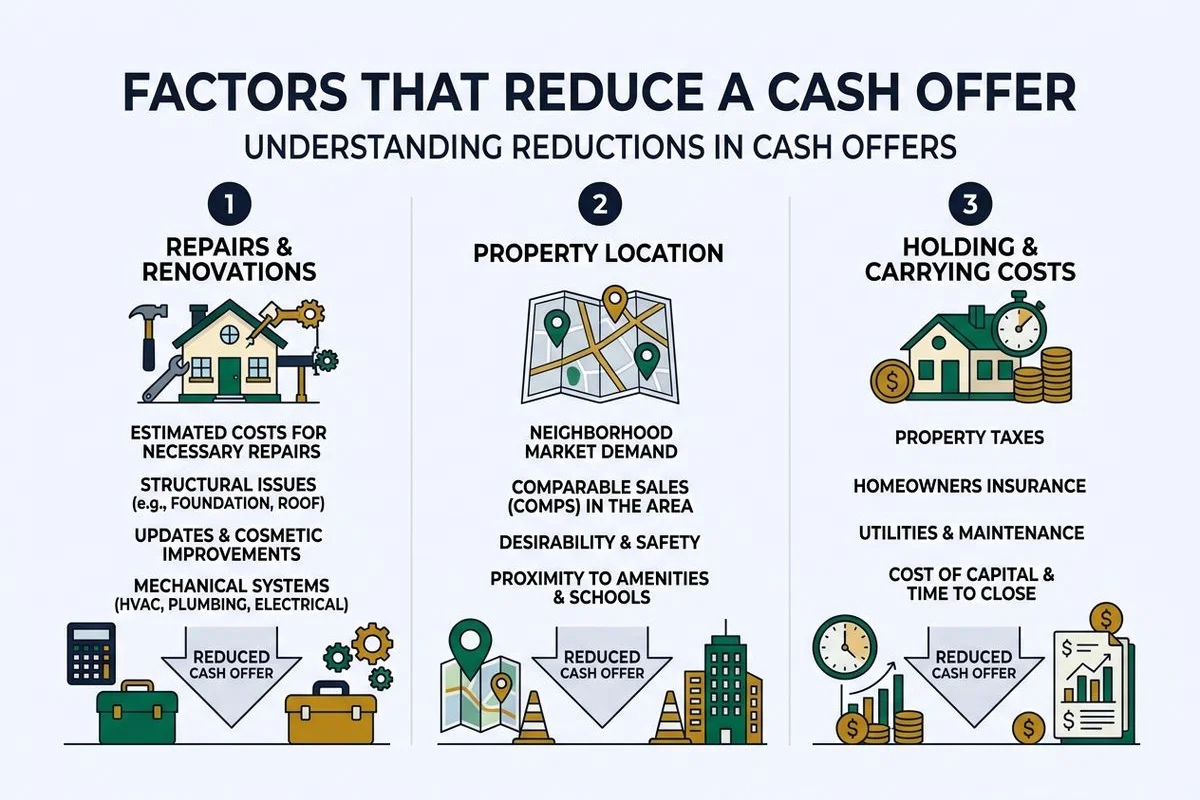
We consistently see condition, location, and necessary repairs as the three main levers that pull an offer price down. The mechanical reality of North Texas soil creates unique challenges.
Our foundation repair experts note that DFW’s expansive clay soil causes frequent structural movement. Average foundation repairs in Frisco or Plano currently run between $5,000 and $8,500 in 2026.
We watch buyers deduct these full retail repair costs directly from their offers. A buyer will not absorb the cost of a $7,000 HVAC replacement out of goodwill.
How Location Shifts the Outcome
Our analysis shows that county specifics play a massive role in demand. High-growth areas in Collin County often command higher percentages than older neighborhoods in Tarrant County.
We know that buyer availability changes based on these hyper-local market temperatures. A home needing a complete retrofit in an established Dallas neighborhood might scare off amateur flippers.
Our team always reminds sellers that Texas law requires full disclosure of known defects. Hiding a plumbing issue will only blow up the deal during the buyer’s inspection period.
How to benchmark an offer you receive
We recommend benchmarking any offer against recent, localized sales data rather than an automated online estimate. The Dallas Central Appraisal District (DCAD) or Tarrant Appraisal District (TAD) tax values often lag months behind the current market.
Our preferred method is to pull a Comparative Market Analysis (CMA) using homes sold for cash within the last 45 to 60 days. The 2026 market has shifted too much to rely on older comparable sales.
We suggest looking closely at the net proceeds rather than the top-line number. One company might offer $350,000 but charge $20,000 in hidden fees.
- Verify the Buyer’s Proof of Funds: Ensure they actually have the cash sitting in a bank account today.
- Check the Earnest Money: A serious DFW investor will typically put down 1% to 2% in non-refundable earnest money.
- Read the Contingencies: Look for hidden inspection periods that allow the buyer to back out at the last minute.
- Confirm the Closing Timeline: A legitimate cash transaction in Texas should take between 7 and 14 days to clear title.
Where to go next
We designed this guide as one piece of a much larger topic.
The parent hub is the best place to start if you are still wondering how much do cash buyers pay dfw: best cash home buyer companies dfw.
- Our related situation guides link out directly from that main page.
- Unsure which lane fits your specific North Texas home?
We will gladly point you to the right guide or company review if you Contact us. A quick conversation can save you thousands of dollars at the closing table.
Related guide: hidden cash-sale costs
FAQ
What percent of value do cash buyers pay in DFW?
It ranges by buyer type and condition — investors often well below market, iBuyers closer.
Why are offers so low?
They price in repairs, holding costs, resale risk, and profit margin.
How do I know if an offer is fair?
Benchmark against a real CMA and compare net proceeds to listing.