Can You Sell a House With Negative Equity in DFW?
Owe more than your DFW home is worth? Compare bringing cash, a short sale, or waiting — with local value context.
Last updated:

Our shared insight is that trying to sell a house with negative equity in DFW is a complex math problem, not a permanent trap. Most homeowners miscalculate the true cost of selling because they forget to factor in local Texas fees.
This guide skips the fluff and walks through what actually matters for an underwater seller in the Metroplex.
We wrote this from the perspective of a licensed Texas real estate agent (TREC #679806), meaning you get grounded local advice instead of national guesswork. You will find exact strategies for handling the gap between your home value and mortgage balance.
State laws enforce specific rules around negative equity that dictate your available options. Our team will cover the specific legal implications and provide clear steps to fit your situation.
Let’s look at the data and explore practical ways to respond. This analytical approach prevents costly surprises.
Bring-cash-to-close vs. short sale vs. wait to sell a house with negative equity in DFW
We want to clearly outline your three options: you can bring personal funds to cover the gap, negotiate a short sale with your lender, or wait for property values to rise. According to 2026 data from iBuyer, seller closing costs in Texas average between 6% and 10% of the final sale price. This high percentage means the cash required to leave the closing table is often much higher than the negative equity alone.
Our advice is to calculate these hidden costs immediately so you understand your true out-of-pocket obligation. Texas does not levy a state transfer tax, but iBuyer notes that high prorated property taxes still drain your net proceeds. Local conditions shift the outcome dramatically based on buyer availability and current market temperature.
We outline the three mechanical paths for an underwater property in DFW:
- Bring Cash to Close: You write a check to the title company to pay off the remaining loan balance and all transaction fees.
- Short Sale: The bank agrees to let you sell the home for less than the mortgage balance, absorbing a loss.
- Wait: You rent the property out or stay put until Dallas home values recover your equity position.
Most sellers in this situation get tripped up by not accounting for the timing and cost side. Before you commit to any option, run your numbers against the Home Sale Net Proceeds Calculator so you are comparing net-to-you instead of the headline offer.
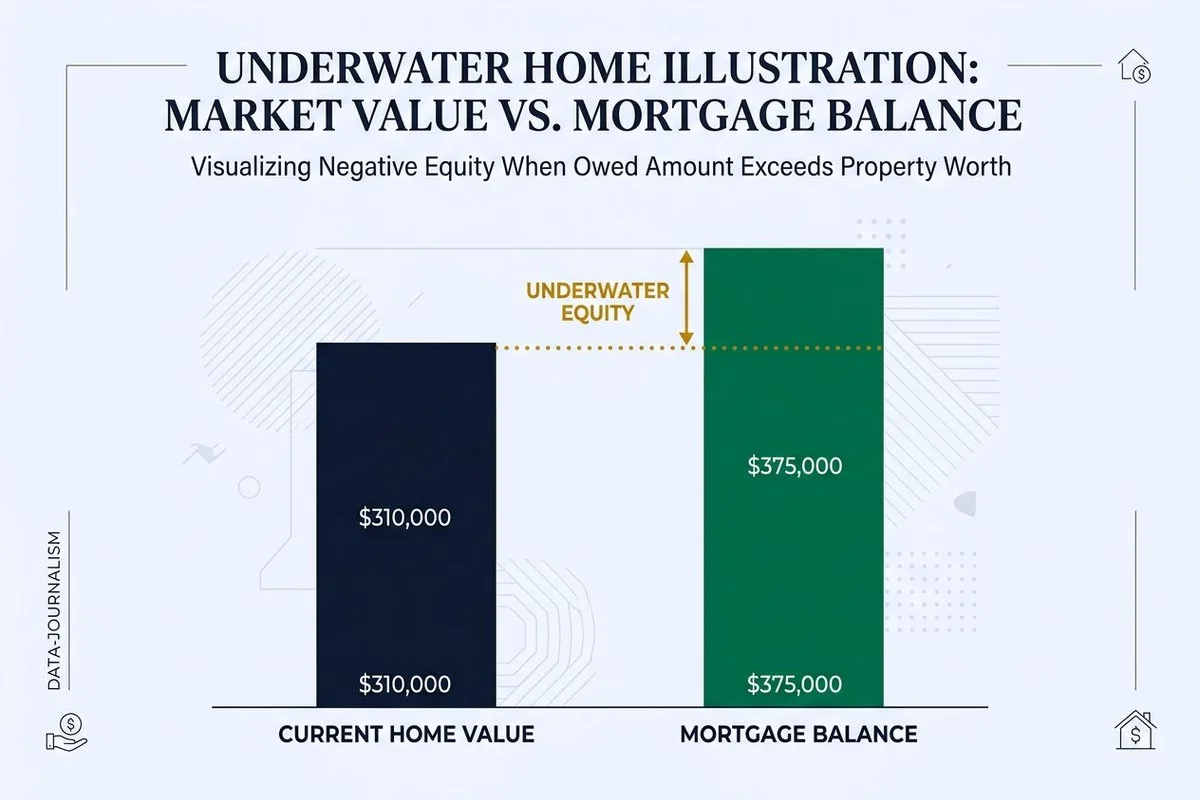
We included a visual breakdown below to help you see how the mortgage balance relates to home value. That graphic illustrates the basic mechanical reality of selling underwater. Review it carefully before moving forward.
How lender approval works when underwater
We must emphasize that getting lender approval for a short sale requires submitting a hardship package that proves you cannot pay the remaining mortgage balance. The bank must officially agree to accept a lower payoff amount before you can legally sell the home to a buyer. The approval process hinges on your ability to prove genuine financial distress, such as a sudden job loss or medical emergency.
Our daily market activity shows that incomplete paperwork is the primary reason banks deny short sale requests in Texas. You need to gather bank statements, tax returns, and a detailed hardship letter to start the conversation. The timeline for this process is much longer than a traditional real estate transaction.
| Feature | Standard Sale | Short Sale |
|---|---|---|
| Approval Authority | Homeowner | Mortgage Lender |
| Closing Timeline | 30 to 45 Days | 3 to 6 Months |
| Credit Impact | Minor | Significant Drop |
| Deficiency Risk | None | Possible (Unless Waived) |
We always warn clients about the lingering risk of deficiency judgments after a short sale closes. Under Texas Property Code Section 51.003, lenders have up to two years to file a lawsuit to collect the remaining unpaid balance. Nolo legal guides confirm that Texas operates as a non-judicial foreclosure state, but banks still retain the right to pursue that debt unless they explicitly waive it in writing.
Our legal contacts strongly suggest demanding a specific waiver of deficiency clause in the final approval letter. Fannie Mae guidelines show that some government-backed loans might offer built-in deficiency waivers to expedite the process under certain conditions. One offer from a buyer is just a starting price.
We urge you to consult with a local real estate attorney to review the lender’s final terms before signing any binding agreements. A documented condition assessment justifies your pricing to the bank during negotiations. This creates a solid negotiation strategy.
DFW value context and whether equity may recover
Our analysis indicates that recovering your equity depends heavily on current mortgage rates and your specific neighborhood sales trends. While the broader Texas market remains stable, rising interest rates have cooled buyer demand and slowed the rapid appreciation seen in previous years. Recent 2026 DALTX Real Estate reports show that more than half of sellers in Dallas cut their asking prices to attract hesitant buyers.
We track these housing metrics closely to help sellers decide if waiting out the market is a realistic strategy. According to ATTOM data, 3.2% of mortgaged homes across the country were seriously underwater in early 2026, meaning the loan balance was at least 25% higher than the market value. The Dallas-Fort Worth area still holds strong pockets of demand, particularly for homes in excellent, move-in condition.
Our clients frequently ask how long they need to wait to break even on their underwater mortgage. A property value recovery could take years if mortgage rates stay elevated near the 6.5% mark recently reported. Local conditions shift the outcome significantly based on county specifics and the current market temperature.
We look at three primary indicators to gauge potential equity recovery in North Texas:
- Active Inventory Levels: Higher inventory means more neighborhood competition and flatter price growth.
- Average Days on Market: Homes sitting longer than 45 days typically signal a transition toward a buyer’s market.
- Neighborhood Price Reductions: Frequent price cuts in your specific zip code suggest localized values are trending downward.
A single offer might just be a lowball bid, but multiple competing offers prove the true market value to both you and your lender. You need a documented condition assessment to justify your pricing to the bank during negotiations.
How to estimate your true payoff gap
We recommend calculating your true payoff gap by subtracting your mortgage balance and estimated closing costs from your home’s realistic market value. Do not use your latest county property tax assessment to determine the market value, as it rarely reflects actual buyer willingness. Many sellers mistakenly assume their only expense is paying off the remaining loan principal.
Our standard process involves listing out every single hidden fee that chips away at your final net proceeds. Recent market reviews show a typical real estate commission in Texas consumes between 5% and 6% of the gross sale price. Prorated property taxes create another massive financial hurdle for sellers without much equity.
We see this often in Texas, where Herring Bank reports that high property tax rates mean a mid-year closing requires handing over several thousand dollars. For example, closing in July on a home with a $7,000 annual tax bill requires the seller to credit the buyer over $4,000 at the closing table. The seller also customarily pays for the owner’s title insurance policy, which costs roughly $2,463 on a $600,000 home in Collin County.
Breaking Down the Math
Our team built a simple approach to help you find the actual gap number before listing. You take the expected sale price and subtract the mortgage payoff, agent fees, title fees, and tax prorations. The resulting negative number is the exact amount of cash you must bring to the title company to finalize the sale.
We always pull a precise payoff quote directly from the loan servicer to ensure strict accuracy. A documented condition assessment allows you to price the home correctly from day one. Finding a realistic starting price prevents surprise repair credits from widening your payoff gap right before closing.
Where to go next
We consider this guide just one piece of a larger real estate strategy.
If you are weighing your next steps, start with the parent hub: sell my house fast dallas. Related situation guides link out from there to cover specific property distress scenarios.
Our local experts are ready to review your property details if you are still unsure which lane fits your specific home. Please Contact us today.
A team member will point you to the right guide or company review to successfully sell a house with negative equity in DFW.
Related guide: short sale vs. foreclosure
FAQ
Can I sell if I owe more than the house is worth?
Yes — via a short sale or by bringing cash to cover the gap at closing.
Will I owe money at closing?
If underwater and not doing a short sale, you may need to bring funds to pay off the loan.
Should I wait for values to rise?
Sometimes — if you can hold; not if a deadline or hardship forces a sale.