Why Grand Prairie Homeowners Need a Quick Sale
DFW Real Estate Review covers Grand Prairie because this city draws fast-sale interest for reasons specific to its geography and housing stock — reasons that look different from Dallas, Fort Worth, Arlington, Irving, or the suburbs that share its borders. Every analysis below is researched by a licensed Texas real estate agent (TREC #679806) who works the DFW market, not a national content writer.
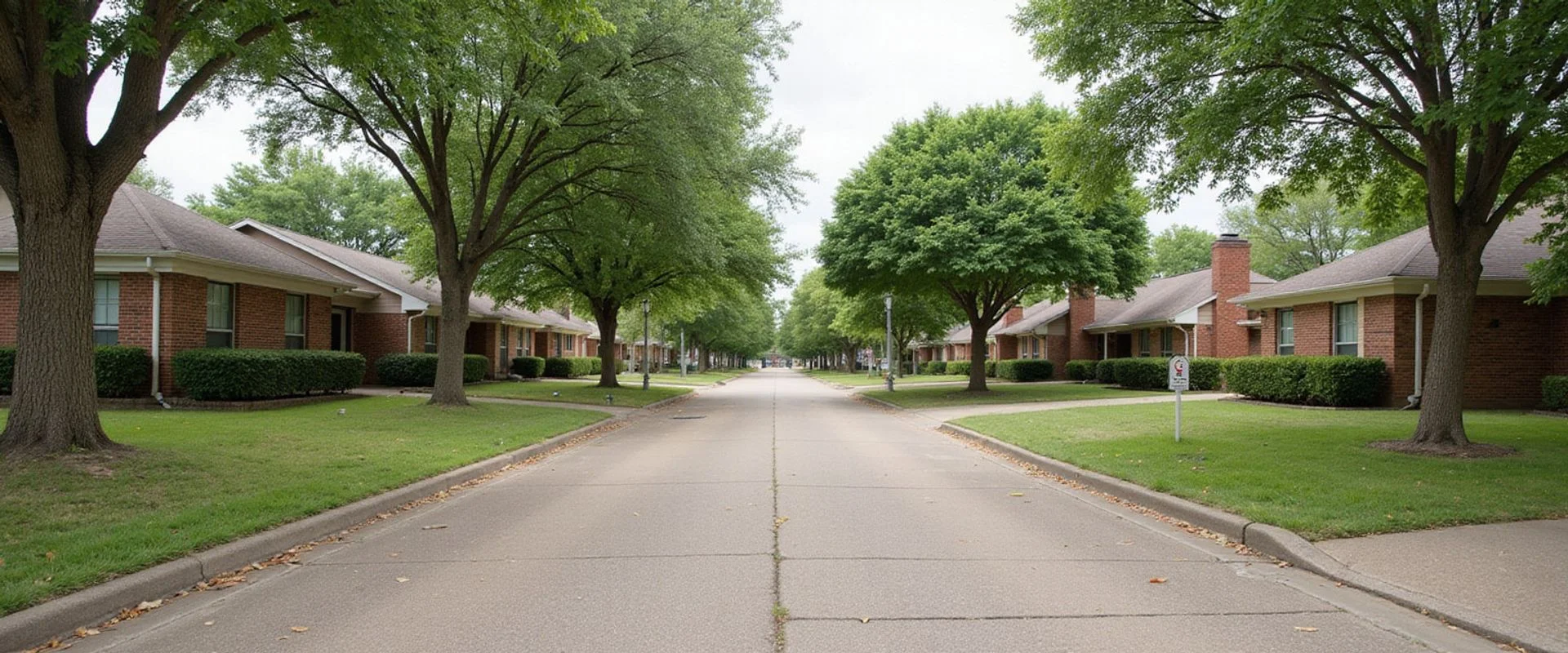
Aging 1970s-1980s South Grand Prairie inventory. The oldest and most affordable section of Grand Prairie consists of brick ranch and traditional homes built in the 1970s and 1980s, primarily south of IH-30 along Belt Line Road, Carrier Parkway, and the Pioneer Parkway corridor. These homes are at the age where major systems fail: roofs, HVAC, plumbing, and foundation movement on DFW’s expansive clay soils. For owners who cannot fund $30,000-$50,000 in updates, the cash-buyer market is often the only practical path forward.
Three-county tax and appraisal complexity. Grand Prairie is the only DFW city that straddles Dallas County, Tarrant County, and Ellis County — each with its own appraisal district, tax rate structure, and administrative timelines. Sellers who inherit a property or face a time-sensitive sale sometimes discover mid-transaction that the appraisal record is filed with a different county than expected. Cash buyers familiar with the Grand Prairie market can navigate these cross-county closings faster than most title companies and traditional lenders.
Lake-area flood zone exposure. Neighborhoods near Joe Pool Lake and Mountain Creek Lake carry FEMA flood zone designations that make conventional financing harder to obtain. Buyers who need a mortgage may walk when flood insurance adds hundreds of dollars per month to their carrying cost. Cash buyers close without that obstacle, though they factor the flood risk into the offer.
Industrial-adjacent corridors. The Great Southwest Parkway and Carrier Parkway corridors host a significant industrial and logistics presence, including Lockheed Martin and Bell Textron operations near the Tarrant County border and Grand Prairie Municipal Airport (GPM). Neighborhoods in the Dalworth Park area and along SH-161 near these corridors attract a narrower owner-occupant buyer pool on traditional listings, and sellers often find that investor and cash-buyer channels close faster and with fewer contingencies.
Rental property exits. Grand Prairie’s affordable price points made it a popular city for small landlords over the past two decades. Landlords who want to exit — due to difficult tenants, deferred maintenance, or simply a desire for liquidity — frequently find a direct cash sale faster and cleaner than preparing a tenant-occupied property for a traditional MLS listing.
Inherited properties. Grand Prairie has a substantial base of homes purchased in the 1960s through 1980s by now-deceased or elderly owners. When those properties transfer to heirs through Texas probate, the combination of distant family members, deferred maintenance, and the need to navigate the correct county court — Dallas, Tarrant, or Ellis depending on where the property sits — creates fast-sale demand that the traditional market cannot absorb quickly.
Four Ways to Sell a House Fast in Grand Prairie
iBuyers in Grand Prairie
Opendoor and Offerpad both operate in Grand Prairie, but their footprint here is thinner than in Dallas proper or the higher-value north suburbs. Homes built roughly 1990-2010 in North Grand Prairie, closer to Irving and the DFW Airport employment zone, are more likely to receive offers. South Grand Prairie’s older inventory — particularly homes built before 1980 with deferred maintenance or foundation movement on clay soil — is routinely declined. Lake-area properties with active FEMA flood zone designations are also typically passed over, because iBuyers avoid properties requiring mandatory flood insurance. If your Grand Prairie home sits in the right condition band and ZIP code, expect 85-92% of market value before a 5-8% service fee.
Direct cash buyers active in Grand Prairie
Grand Prairie’s direct cash-buyer market is active, particularly in South Grand Prairie where the older affordable inventory is well-suited to renovation-and-hold or renovation-and-flip strategies. HomeVestors franchises, regional investment companies, and local operators all source deals here. On habitable, standard-condition homes near the $300k median, direct cash buyers typically offer 75-85% of market value with no service fee and close in 7-14 days. Distressed South Grand Prairie homes needing major work see 60-75% of after-repair value. Collecting at least two direct cash offers is worth the effort — on a $300k home, two quotes can differ by $15,000-$25,000.
Wholesalers in Grand Prairie
Wholesaler activity in Grand Prairie mirrors the pattern in other affordable DFW submarkets: high volume of postcard and mailer marketing, and a buyer profile that is often not the end purchaser. If you received a handwritten postcard, a yellow-card mailer, or a call from someone who cannot provide proof of funds when asked, you are likely talking to a wholesaler. Wholesalers sign a contract and assign it to an end investor for a fee — the difference between what the end buyer pays and what the wholesaler offered you comes directly out of your net proceeds. Texas law permits assignment but requires disclosure if you ask directly. Always ask: “Are you the end buyer, or are you assigning this contract?” and request written proof of funds.
Speed-focused agents and flat fee MLS
A listing agent experienced with Grand Prairie’s investor buyer pool can occasionally net more than the cash-buyer lanes above by marketing to a curated list of active buyers through NTREIS. This lane works best for homes in habitable condition that can be shown quickly and are not in flood zones or adjacent to heavy industrial corridors. A flat fee MLS listing is an option if you are comfortable managing the process and your home qualifies for conventional financing. For South Grand Prairie distressed properties or lake-area flood zone homes, this lane rarely competes with a direct cash offer on an adjusted net-proceeds basis.

What Cash Buyers Actually Pay in 2026
Grand Prairie’s median home price sits in the $280,000-$320,000 range for standard-condition properties. Here is how the DFW Real Estate Review team breaks down the four lanes into actual net proceeds on a $300,000 Grand Prairie home.
- iBuyer: 85-92% of market value before a 5-8% service fee. On $300,000, a headline offer around $255,000-$276,000 nets approximately $246,000-$261,000 after fees.
- Direct cash buyer, standard condition: 75-85% of market value, no service fee. Net approximately $225,000-$255,000, with a 7-14 day close.
- Wholesaler: 60-70% of after-repair value. On a standard-condition $300,000 home, net proceeds land around $180,000-$210,000.
- Traditional listing: After approximately 5% commission and closing costs, net approximately $265,000-$275,000, but that timeline runs 60-90 days and requires the home to show well and qualify for conventional financing.
Grand Prairie property taxes of 2.4-2.7% add $600-$675 per month in holding cost on a $300,000 home. Every month a traditional listing extends adds that amount to your actual cost of waiting — a real input when you are running the break-even math between a fast cash offer and a longer traditional timeline.
| Selling lane | Typical net on a $300k Grand Prairie home | Typical time to close |
|---|---|---|
| iBuyer (Opendoor / Offerpad) | $246,000-$261,000 (after 5-8% service fee) | 14-30 days |
| Direct cash buyer, standard condition | $225,000-$255,000 (no service fee) | 7-14 days |
| Wholesaler | $180,000-$210,000 (spread taken by assignee) | 7-21 days |
| Traditional / flat fee MLS listing | $265,000-$275,000 (after approx. 5% commission) | 60-90 days |
For the full cost-of-selling picture, including title policy, prorations, and a worked net-proceeds example, see the cost to sell a house in Texas guide and run your specific numbers through the Home Sale Net Proceeds Calculator.
How the Three-County Tax Situation Affects Your Sale
This is the single most important fact a Grand Prairie seller needs to understand that no other DFW city seller faces in quite the same way.
Grand Prairie sits in three separate counties: Dallas County, Tarrant County, and a sliver of Ellis County. Each has its own appraisal district — Dallas CAD, Tarrant CAD, and Ellis CAD — and each sets your property’s assessed value independently. The county your property is in determines your county tax rate, your school district assignment, and which county court handles any probate, lien, or legal matter tied to your property.
Why this matters for a fast sale:
A Grand Prairie seller who contacts a cash buyer or iBuyer without knowing their county can run into administrative friction that adds days or weeks to a closing. Title work for a Grand Prairie property must confirm which county the deed is filed in, pull tax records from the correct CAD, and verify that no liens or tax delinquencies are registered at the wrong county by mistake — a more common problem here than in single-county cities. Cash buyers who specialize in Grand Prairie know to check all three CADs; buyers less familiar with the market sometimes do not, and that creates delays.
How to find out which county your Grand Prairie property is in:
The fastest method is to run your address through each county’s online property search:
- Dallas CAD: dallascad.org
- Tarrant CAD: tad.org
- Ellis CAD: elliscad.org
Your most recent property tax statement also names the appraisal district. If you have not received a statement, check your recorded deed or the county clerk’s online records for whichever county you believe applies.
What it means for school districts:
Grand Prairie ISD covers most of the city, but parts of Grand Prairie fall under Arlington ISD in certain southern sections, and a small portion near the Ellis County border sits in Mansfield ISD. The ISD assignment can shift a home’s appeal to buyers with school-aged children and affects days on market on a traditional listing. Cash buyers are generally ISD-agnostic, but accurate ISD disclosure belongs on your TREC Seller’s Disclosure Notice regardless of the sale method.
What it means for holding costs:
Property tax rates vary across the three county portions of Grand Prairie. A home in the Dallas County portion carries Dallas County rates appraised by Dallas CAD; a home in the Tarrant County portion goes through Tarrant CAD at Tarrant County rates; the Ellis County sliver uses Ellis CAD. Combined effective rates — county, city, ISD, and special districts — typically range from 2.4% to 2.7% across the city. On a $300,000 home, the difference between 2.4% and 2.7% is $900 per year in holding cost. That is not a defining number on its own, but it matters when you are holding a vacant property for months during a drawn-out traditional sale.
Neighborhood Breakdown: Where Offers Vary Most
South Grand Prairie is the oldest, most affordable, and most investor-active part of the city. Homes here were largely built in the 1960s through the 1980s, with concentrations of brick ranch-style properties near Carrier Parkway, Belt Line Road, Camp Wisdom Road, and the IH-30 corridor. This submarket draws the highest concentration of direct cash buyers and wholesalers in the city. Traders Village — one of the largest flea markets in the United States — and the Lone Star Park horse racing facility are both anchored in this part of Grand Prairie. iBuyer coverage is thin in South Grand Prairie, and traditional listing days on market run longer than the city average because the buyer pool skews heavily toward investors. If you own a South Grand Prairie home and need to sell fast, the direct cash-buyer lane is your first and most reliable call.
North Grand Prairie sits closer to Irving and the DFW Airport employment corridor along SH-161 and TX-360. Values here are somewhat higher than the city median, and the buyer profile is more similar to Irving or mid-value Dallas suburbs than to South Grand Prairie. iBuyer coverage is more consistent in this part of the city, and traditional listings move faster here. Sellers in North Grand Prairie have all four buyer lanes available, though the direct cash-buyer lane remains competitive on net proceeds after accounting for the iBuyer service fee.
Lake-area communities near Joe Pool Lake and Mountain Creek Lake carry flood zone exposure that most other Grand Prairie neighborhoods do not. Some of these properties fall in FEMA Zone A or Zone AE, which requires flood insurance for any buyer using conventional financing — a cost that sometimes causes financed buyers to withdraw. This narrows the traditional buyer pool significantly and makes cash buyers the most practical channel for most lake-area sellers. Epic Waters Indoor Waterpark, the major entertainment draw in this corridor, is nearby but does not change the flood zone math for residential sellers.
The Great Southwest corridor and industrial-adjacent neighborhoods along Great Southwest Parkway and Carrier Parkway sit near Grand Prairie’s significant industrial and logistics footprint. Proximity to Lockheed Martin and Bell Textron operations near the Tarrant County border, and to Grand Prairie Municipal Airport (GPM), creates commercial traffic and noise factors that affect some residential buyer profiles. These neighborhoods attract investor buyers more than owner-occupants on traditional listings, making cash and investor channels the more efficient path.
Seller Situation Guides for Grand Prairie
Situation guides written for Texas law and localized to the DFW market:
- Pre-foreclosure in Texas — particularly relevant when three-county tax complexity compounds an already-tight financial timeline
- Selling a house during divorce in Texas — covering county-specific court timelines and the TREC contract for Grand Prairie properties
- Inherited house with multiple heirs — common in South Grand Prairie estate situations where heirs must identify the correct county probate court before anything else can happen
- Rental property with tenants in DFW — relevant for Great Southwest corridor landlords and South Grand Prairie rental property owners exiting the business
- How to sell a house fast when relocating from DFW — applies to Lockheed Martin and Bell Textron employee transfers and other Grand Prairie employment relocations
Your Next Steps to Sell Fast
If you have a Grand Prairie home and a real timeline, the minimum research is: confirm which county your property is in, get an iBuyer offer (if your home and location qualify), get an offer from at least one direct cash buyer, and get a listing-price opinion from a speed-focused agent who has closed deals in your specific part of Grand Prairie. The county question is not optional — it determines how fast your title work moves and what your actual holding cost is while you wait.
Run all the offers through the Home Sale Net Proceeds Calculator to see the actual number that hits your account after county property taxes, closing costs, and your mortgage payoff. The gap between a cash offer and a traditional listing net narrows when you include Grand Prairie’s holding costs in the math.
If you want the ranked list of specific companies to contact, the 2026 DFW cash home buyer rankings has per-company scoring, fee breakdowns, referral disclosure, and independent verdicts on who is and is not worth calling for a Grand Prairie home.