Why Midlothian sellers search for a fast sale
DFW Real Estate Review is an independent real estate review site operated by a licensed Texas agent (TREC #679806), covering the Dallas-Fort Worth market since 2016. Most people searching “sell my house fast Midlothian TX” are dealing with a specific deadline or a specific problem. Midlothian’s position as one of the most affordable new-construction markets in Dallas-Fort Worth creates fast-sale dynamics that differ from neighboring Mansfield, Cedar Hill, Red Oak, and Waxahachie in ways sellers rarely anticipate before going to market.
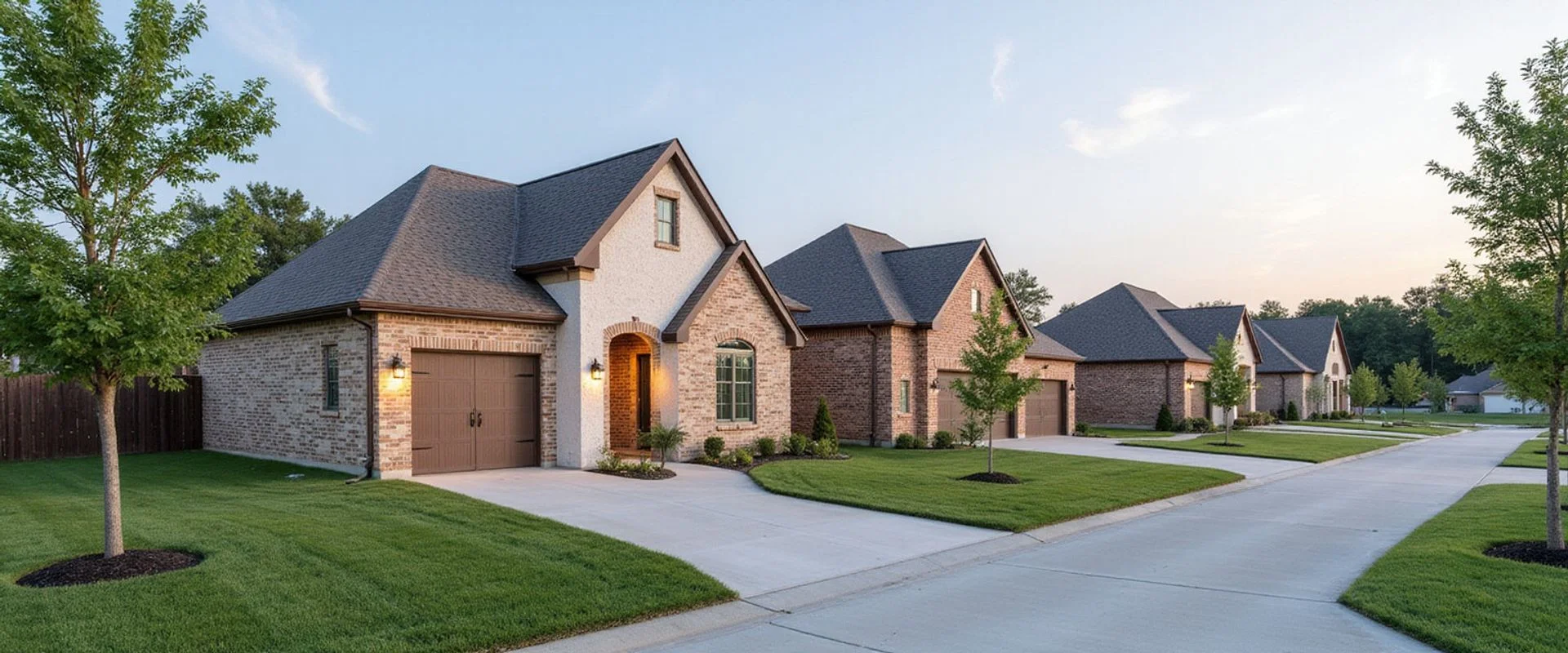
Heavy builder competition against resale. Midlothian’s master-planned communities — Hawkwood, Woodbridge, Inspiration, Sagewood, the Crystal Lagoon development — are actively selling new construction in the $280,000-$380,000 range with incentives that resale sellers cannot match. Rate buydowns, appliance packages, design center credits, and builder warranties give financed buyers a reason to choose new over used at the same price point. A resale home competing against a brand-new build in the same master-planned community faces a difficult comparison. For sellers who cannot fund updates or staging to close that perception gap, the certainty of a fixed-date cash offer is more attractive than a traditional listing that risks stalling against an active builder phase next door.
Cement plant proximity affecting some neighborhoods. Midlothian has been called the Cement Capital of North Texas for good reason: the city hosts three active large-scale cement manufacturing facilities — Martin Marietta (formerly TXI), CRH (formerly Ash Grove), and Holcim. These plants are a significant part of Midlothian’s industrial identity and employ thousands of local workers. For home sellers, the relevant consideration is proximity. Properties near the plants, particularly along US-67 south and along FM 663, may experience dust, heavy cement truck traffic, and air quality conditions that affect how many conventional lenders will finance a purchase and how many buyers will bid. Sellers in those corridors should expect a narrower financed buyer pool and should factor that into their timeline expectations on a traditional listing.
Rising Ellis County property taxes. Ellis County appraisals have risen steadily as Midlothian grows. Property taxes calculated on a rising ECAD assessed value represent a real carrying cost during any traditional listing period that stretches past 30 days. Sellers who need to avoid two additional months of property taxes and mortgage payments on a home they have already mentally moved out of often find the math on a fast cash sale more attractive when carrying costs are included in the full net-proceeds comparison.
Newer homes with builder warranty issues. Midlothian’s housing stock skews newer than much of the DFW metro — a significant share is 5-15 years old, built during the master-planned community boom. Newer single-family homes sometimes carry unresolved builder warranty items: foundation settlement on expansive clay soil, HVAC issues, roof defects, or drainage problems that surfaced after the builder’s warranty window closed. Sellers who inherited warranty disputes from prior owners, or who are dealing with items a builder denied coverage for, can find that these issues complicate a traditional listing while a direct cash buyer can absorb the repair risk.
Four Ways to Sell Your Midlothian Home Fast
iBuyers in Midlothian
Opendoor and Offerpad both have coverage in Midlothian for eligible properties, but coverage is not uniform across the city. Standard 3-4 bedroom single-family homes in master-planned communities away from the cement plant corridor are the strongest candidates. Rural parcels on the outskirts of Midlothian, homes in older sections of the city with original 1980s-2000s systems, and properties close to industrial facilities may be declined outright or receive low-confidence offers. A 5-8% service fee on a $360,000 Midlothian home represents $18,000-$29,000 in direct friction. For standard Midlothian homes in good condition where a traditional listing is viable, iBuyers rarely net sellers as much as a well-priced listing with a local agent.
Direct cash buyers active in Midlothian
Direct cash buyer activity in Midlothian concentrates in two areas: older housing stock in the original Midlothian core where renovation margins are workable, and near the cement plant corridor where the conventional-financing buyer pool is narrow and cash buyers who understand the local market can move where financed buyers cannot. Offers on standard-condition habitable Midlothian homes typically land at 78-84% of market value. Newer master-planned community homes in good condition see lower cash buyer activity because renovation margins at those price points are thin — the traditional listing or iBuyer lane is more practical for sellers in those communities.
Wholesalers in Midlothian
Wholesaler activity exists in Midlothian, particularly in the older sections of the city and along the US-287 corridor. The handwritten letters and postcards that circulate across DFW reach Midlothian mailboxes regularly. If someone cannot show proof of funds immediately or describes having investors ready, you are likely dealing with a wholesaler who will assign your contract rather than close on it directly. Texas law requires them to disclose this if you ask directly, but it will not be volunteered. Always ask: “Are you the end buyer, or will you assign this contract?” Proceeds through a wholesaler are consistently lower than through a direct cash buyer.
Speed-focused agents and flat fee MLS
For newer Midlothian homes in active master-planned communities away from the cement plant corridor and in good condition, a listing with an agent who understands the specific Midlothian submarket is the highest-net option — assuming you can wait 45-90 days and accept the risk of a withdrawn buyer during the option period. Flat fee MLS is viable for sellers whose home qualifies for conventional financing without repair conditions. For properties near the cement plant corridor where the financed buyer pool is narrower, or for homes competing directly against an active builder phase in the same community, the traditional listing lane carries real risk that a cash offer eliminates.
What Cash Buyers Actually Pay in 2026
Here is how the four lanes translate into actual numbers for a representative Midlothian home at $355,000.
| Selling lane | Typical net on a $355k Midlothian home | Typical time to close |
|---|---|---|
| iBuyer (Opendoor / Offerpad, if eligible) | $279,000-$306,000 (after 5-8% fee) | 14-30 days |
| Direct cash buyer, standard condition | $278,000-$298,000 (no fee) | 7-14 days |
| Wholesaler | $230,000-$265,000 (spread taken by assignee) | 7-21 days |
| Traditional listing | $320,000-$330,000 (after approx. 5% commission) | 45-90 days |
Ellis County property taxes on a Midlothian home vary based on ECAD’s assessed value, your school district assignments, and any municipal utility district (MUD) fees within master-planned communities — MUD assessments in communities like Woodbridge and Inspiration can add meaningful carrying cost to an extended listing timeline. Confirm your complete tax and fee obligation before building your comparison numbers.
For the full cost-of-selling picture, run your numbers through the Home Sale Net Proceeds Calculator and review the cost to sell a house in Texas guide.
The cement plant reality
Midlothian’s cement manufacturing heritage is part of what makes it unique in the DFW metro. The three active plants — Martin Marietta (formerly TXI), CRH (formerly Ash Grove), and Holcim — are among the largest employers in Ellis County and a consistent source of local jobs and tax revenue. For most of Midlothian’s residential market, the plants are a background fact of city identity, not a daily concern.
The nuance is proximity. Properties situated near the plant facilities along US-67 south and FM 663 are in a different situation from homes in Hawkwood, Woodbridge, and Inspiration, which are positioned farther from the industrial corridor. Sellers near the plants should factor in several considerations.
Dust and air quality. Cement production generates particulate matter. TCEQ (Texas Commission on Environmental Quality) monitors local air quality, and the plants operate under permits, but neighbors in close proximity can experience dust deposition. Some conventional lenders in Texas require additional disclosures or environmental assessments for properties within certain distances of active industrial facilities, which can narrow the conventional-financing buyer pool.
Heavy truck traffic. US-67 and FM 663 carry regular cement truck traffic to and from the plants. For homes fronting or near these corridors, traffic noise and frequency can be a negative factor in the eyes of financed buyers comparison-shopping in quieter residential neighborhoods. Cash buyers who specialize in industrial-adjacent properties understand this dynamic — they are not deterred by it the way a financed retail buyer may be.
TREC seller’s disclosure obligations. Texas Property Code Section 5.008 requires sellers to disclose known material facts about the property. Known proximity to industrial facilities, any past dust or air quality complaints, and any TCEQ notices the seller is aware of should be disclosed on the seller’s disclosure form. Failing to disclose known material conditions creates legal exposure.
The practical implication. DFW Real Estate Review’s analysis of the Midlothian market shows that if your address is near the cement plant corridor, expect a narrower conventional-financing buyer pool and longer days on market in a traditional listing. A cash buyer who knows the Midlothian market and understands industrial adjacency is the most efficient lane. The difference in net proceeds between a cash offer and a traditional listing narrows considerably when carrying costs, failed financing contingencies, and longer marketing periods are factored in for cement-adjacent properties.
How Builder Competition Affects Resale Sellers
The new-construction competition angle is the most broadly applicable fast-sale challenge for Midlothian resale sellers — and it applies even to sellers whose homes are nowhere near the cement plant corridor.
Midlothian’s master-planned communities are actively selling new homes with incentives that resale sellers cannot replicate. A builder in Inspiration or Hawkwood can offer a rate buydown that lowers a buyer’s monthly payment meaningfully, an appliance package worth $8,000-$12,000, and a closing cost contribution that reduces out-of-pocket expenses at signing. Against that offer, a resale seller’s home — even if it is in excellent condition — carries a perception disadvantage in the eyes of a financed buyer who is comparison-shopping at the same price point.
The problem is most acute for resale sellers in the $280,000-$380,000 range competing in the same master-planned community where active phases are still selling new construction. A home in Phase 1 or Phase 2 of a Midlothian development competing against a brand-new home in Phase 4 or Phase 5 of the same community is a difficult comparison, because the later-phase buyer gets a warranty, customization options, and newer systems that the earlier-phase resale does not offer.
What Midlothian resale sellers can do.
Homes that are already updated — new roof, HVAC, kitchen, flooring — can differentiate against new construction where buyers will need to budget for future wear and tear on systems that are now 5-15 years old. Homes on larger or more established lots with mature landscaping have a genuine advantage over new builds on minimal-landscaping developer lots, if that characteristic is promoted actively. Sellers who can document lower HOA or MUD fees than active phases also have a cost-of-ownership argument that narrows the gap for budget-conscious buyers.
For resale sellers who cannot fund updates and whose homes are competing directly against active builder phases, the certainty and speed of a cash offer — even at 78-84% of market value — may be the better net outcome when builder competition is factored into a realistic days-on-market estimate and the carrying cost of an extended listing is calculated honestly.
The Waxahachie comparison. Buyers shopping the southern DFW market sometimes cross-shop Midlothian resale inventory against Waxahachie, approximately 10 miles south and the Ellis County seat. Waxahachie offers its own new construction pipeline at comparable and sometimes lower price points. Midlothian’s advantage is proximity to the DFW metro core via US-67 and US-287, and Midlothian ISD’s standing - anchored by Midlothian High School and Midlothian Heritage High School - as a respected Ellis County district. But sellers need to be aware that the competitive pressure on Midlothian resale pricing comes from multiple directions — not just from within Midlothian’s own active builder phases.
Seller Situation Guides for Ellis County
Situation guides written for Texas law and localized to DFW:
- Pre-foreclosure in Texas — relevant when Ellis County property tax increases compound financial pressure on a Midlothian home
- Selling a house during divorce in Texas — Ellis County family court matters run through Waxahachie; Midlothian sellers going through divorce should confirm which court has jurisdiction for their specific address
- Inherited house with multiple heirs — Ellis County probate context applies for inherited Midlothian homes with distant heirs, deferred maintenance, or unresolved builder warranty issues
- How to sell a rental property with tenants in DFW — relevant for Midlothian landlords exiting rental properties in the older sections of town or near the industrial corridor
- How to sell a house fast when relocating from DFW — applies to Midlothian homeowners facing hard deadlines tied to job transfers or PCS military orders
What to do next
If you have a Midlothian home and a real timeline, start by confirming your ECAD assessed value and your specific address’s proximity to the cement plant corridor — those two data points determine whether the traditional listing or cash lane is more realistic for your situation. Then collect: an iBuyer offer (if your home and location qualify), an offer from at least one direct cash buyer familiar with the Ellis County market, and a listing-price opinion from an agent who knows the specific Midlothian submarket your home is in. If you are searching for cash home buyers near you in Midlothian, the rankings page below lists every company we have reviewed that actively operates in Ellis County. Run all three through the Home Sale Net Proceeds Calculator with your actual Ellis County property taxes, MUD assessments, closing costs, and mortgage payoff before making any decision.
For the ranked list of specific companies to contact for a Midlothian home, DFW Real Estate Review’s 2026 DFW cash home buyer rankings has per-company scoring, fee breakdowns, referral disclosure, and independent verdicts on who is and is not worth calling for an Ellis County seller.